
Running a Sex Offender Check in Charlotte County
The Virginia Department of State Police maintains the Virginia Sex Offender and Crimes Against Minors Registry. It is the controlling public system for Charlotte County. The county does not publish a separate sheriff registry, map, or app. Searchers should use the statewide portal first, filter the geography to Charlotte, and open the full state profile before relying on a list view.
Name and place searches answer different questions. A name search helps when the identity is known, while an address, ZIP, county, radius, map, or list view can support awareness near a place. A partial or common-name result is not enough for a match. Compare the photograph, aliases, physical traits, address, registration status, offense details, and conviction jurisdiction shown by the official profile.
Charlotte County Registry Filter
The Charlotte County dropdown is the clearest starting point for a broad Charlotte County registry check. Rural settlement patterns make a town name alone too narrow. Charlotte Court House is an unincorporated place, while Keysville, Drakes Branch, and Phenix are incorporated towns. A Charlotte County filter avoids treating those place labels as separate registry systems.
The registry also supports address and geographic controls. Use map and list views to read results in context, but do not publish unverified radius choices. The live mileage options were not reliably captured in official indexed text. Search the current portal and use only the values it presents. A map marker may show where a record is plotted; it does not replace the complete profile or confirm that a person is at a location at the moment of a search.
Searching the Virginia Sex Offender and Crimes Against Minors Registry
The Virginia Sex Offender and Crimes Against Minors Registry is free and statewide. VSP maintains the central data. Begin by reading and accepting any lawful-use notice, then choose either an identity-based search or a geographic search. The portal's county field lets users select Charlotte without relying on a commercial lookup service.
- Open the official VSP registry and acknowledge the disclaimer or use conditions shown by the live site.
- Enter a last, first, or middle name, or use an address, city, ZIP, county, and available radius controls for a place search.
- Review the result list or map and compare lawful identifiers. Do not assume that a similar name establishes identity.
- Open the complete profile and read status, address, traits, offense, conviction, vehicle, and verification details in context.
| Field label | Type | Required | Use |
|---|---|---|---|
| Last, First, Middle Name | Text | Conditional | Identity search; confirm live partial-match behavior |
| Address, City, ZIP | Text | Conditional | Geographic search near a known place |
| County | Dropdown | No | Select Charlotte for countywide results |
| Radius | Dropdown | No | Applies to proximity searches; use the live choices |
| Map or List | View control | No | Changes the result presentation |
| Disclaimer | Checkbox or button | When shown | Acknowledges lawful-use terms |
A Charlotte County registry search may return several profiles or none. Treat that result as a view of current public registry data, not a full criminal-record finding.
Charlotte County NSOPW Registry Search
A Charlotte County filter cannot show a registration maintained only by another jurisdiction. The U.S. Department of Justice National Sex Offender Public Website adds a cross-state search layer. It brings participating jurisdiction searches together, which can help when a person recently moved or an address lies near a state line.
The official NSOPW search interface shows why the national layer supplements the Charlotte County registry instead of replacing it.
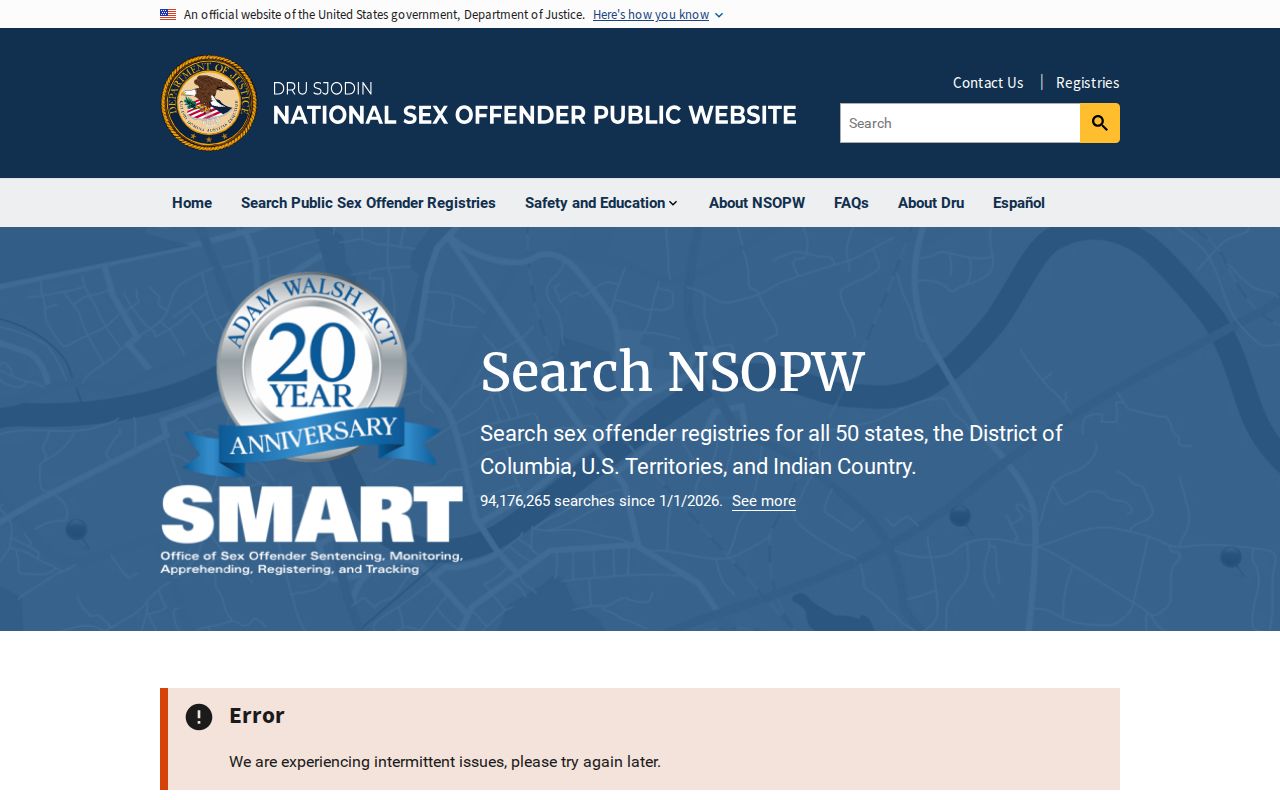
Return to the VSP profile for Virginia details and contact the listed jurisdiction when a national result needs correction or current confirmation.
Search scope matters. A name query can cross jurisdictions, but geography, publication rules, update timing, and profile fields differ by state or territory. Never merge profiles from separate systems based on a name alone.
What a Registry Profile Shows
Virginia publishes a statutory set of profile details for public safety. The field inventory below describes the official schema without retaining a private registrant's identity. Some fields appear only when applicable or when the law permits public release. A profile is not a full court file, police report, or general criminal-history response.
| Name and aliases | Published identity and alternate names associated with the registration. |
|---|---|
| Photo and traits | Photograph plus sex, race, age or birth data, height, weight, hair, eyes, and identifying marks where published. |
| Registered address | The residential location displayed under Virginia's dissemination rules. |
| Offense and conviction | Qualifying offense, Code section, conviction jurisdiction, and date where shown. |
| Tier and status | Offense-based tier, registration standing, and verification information available to the public. |
| Other published details | Vehicles and legally disseminated work or school information, plus scars, marks, or tattoos when present. |
Read each Charlotte County field as of the portal's update cycle. An address is a registration record, not an invitation to approach a person or property. When a field appears wrong, use the reporting routes maintained by VSP or the sheriff instead of reposting the profile.
Charlotte Registry Data and Compliance
VSP maintains the statewide registry database. The Charlotte County Sheriff's Office handles local law-enforcement and compliance questions within its authority. These roles are related but not interchangeable. A central profile error should go to the VSP Sex Offender Registry unit at (804) 674-2825. A question about local compliance can begin with the sheriff at 222 Law Lane, Charlotte Court House, VA 23923, (434) 542-5141.
No verified Charlotte County sheriff app or town police app provides registry alerts or a separate map. The official sheriff site documents the local office, while the county government gateway carries county notices and department routes. Do not confuse this Virginia county with a same-named county in another state. A missing local app is not a missing Charlotte County registry. The VSP portal remains the official Virginia search source, while NSOPW supplies the national supplement.
Note: Report a suspected data error to VSP and a local compliance concern to Charlotte County law enforcement without confronting a registrant.
Registration Requirements and Levels in Virginia
Virginia tiers are based on qualifying offenses under § 9.1-902, not a local risk score assigned by Charlotte County. Registration and reregistration duties are governed by current Virginia law, including § 9.1-903 and § 9.1-908. The common shorthand that Tier I lasts 15 years and Tier II lasts 25 years is misleading. Duties continue until the law or a court order ends them.
The official registration-duty statute shows the legal source behind Charlotte County registry obligations.
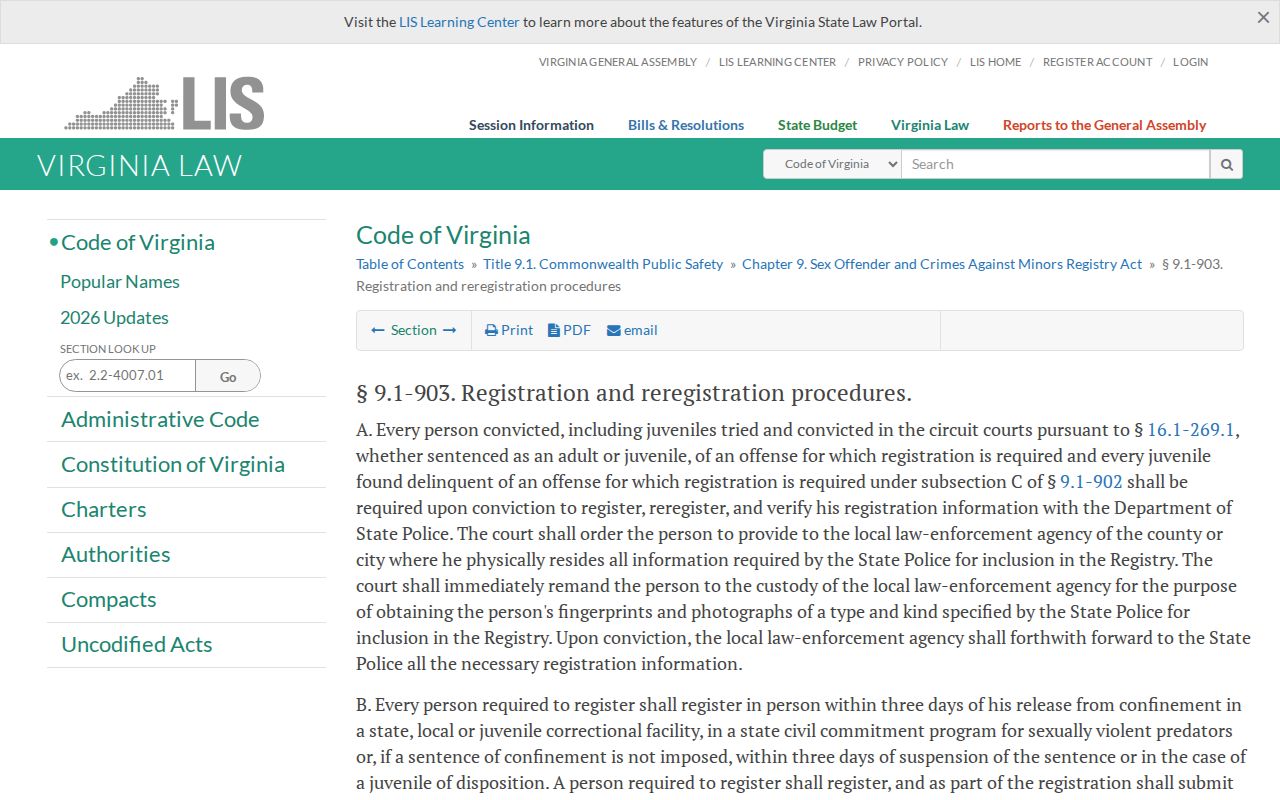
The statutory page should be read with current tier, reregistration, and removal provisions because one section alone does not decide the full duty.
| Virginia tier | Duration | Verification framework |
|---|---|---|
| Tier I | Continues unless ended under applicable law or court order; a qualifying single Tier I registrant may petition no earlier than the statutory 15-year point. | Annual registration rules apply, plus event-based updates required by law. |
| Tier II | Continues until a lawful end; a flat 25-year claim is not supported by § 9.1-908. | Annual registration rules apply, plus required updates. |
| Tier III and specified categories | Lifetime for Tier III, murder, and former § 18.2-67.2:1 categories. | More frequent reregistration obligations apply under the current statute. |
Charlotte County Registry Removal Petitions
Removal is not automatic just because a stated number of years has passed. Virginia Code § 9.1-910 controls eligibility and timing. A person registered for one Tier I offense may petition no earlier than 15 years from the later statutory starting point. Confinement or civil commitment can toll, or pause, the applicable period, and exclusions can bar relief.
The official removal statute captures the distinction between reaching a date and qualifying for a court order.
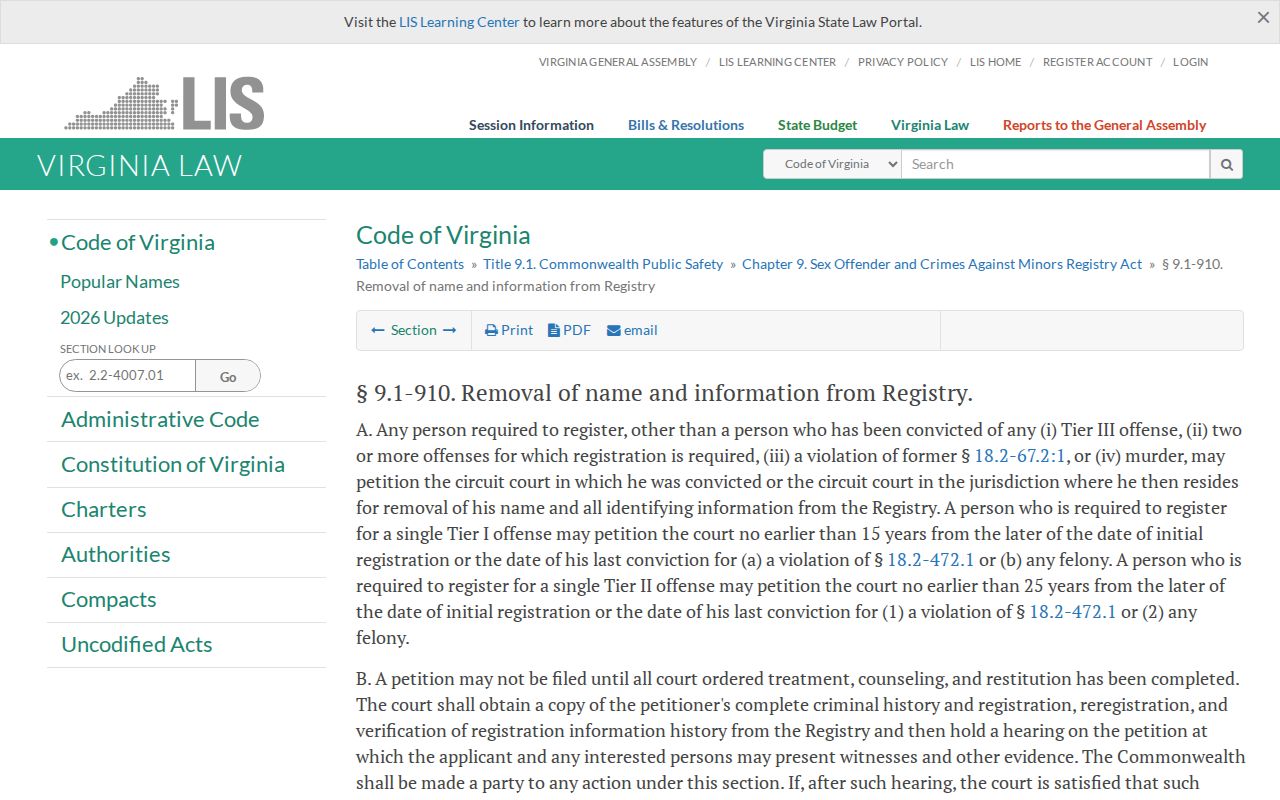
The image supports a narrow rule: check the live statute and the exact registration history rather than relying on a tier-duration chart alone.
A Charlotte County registry profile may remain public while a petition is pending. Only an authorized court process changes a Charlotte County registration duty. Searchers should not infer eligibility, denial, or noncompliance from the passage of time.
Charlotte County Registry Map Context
Charlotte County covers about 475 square miles and has a low population density. That geography makes both countywide and proximity searches useful. A broad county list can reveal records outside the best-known town labels, while a radius or address search can focus on a home, school route, park trip, or family visit. Use only the distance options shown by the live portal.
Charlotte County map results still need close reading. Rural mailing addresses, town names, ZIP boundaries, and county lines do not always describe the same area. Open the profile and compare its jurisdiction and address fields. NSOPW can add nearby out-of-state or cross-jurisdiction data, but VSP remains the source for the Virginia entry.
Lawful Use and Community Notification
The Charlotte County registry exists for personal, family, and community safety awareness. Use it to understand published information, plan ordinary precautions, and provide a well-founded concern to the proper agency. Do not export a profile into a private database, republish identifying details, enter private property, or use the record to pressure a registrant or household. Public access does not remove legal limits on conduct.
Virginia misuse warning: Under § 9.1-918, willful unauthorized use, intimidation, or harassment through registry information is a Class 1 misdemeanor.
Republication alone is not always intimidation, but aggravating conduct can trigger the statute. The safe response to a suspected violation is a report to VSP or the Charlotte County Sheriff. Emergencies belong with emergency services. Data disputes should go to the agency responsible for the entry, not to the person named in it.